Interviewer: "What's your favourite sport?"
Me: "Formula 1 Grand Prix. The car crosses the line. The people create the result."
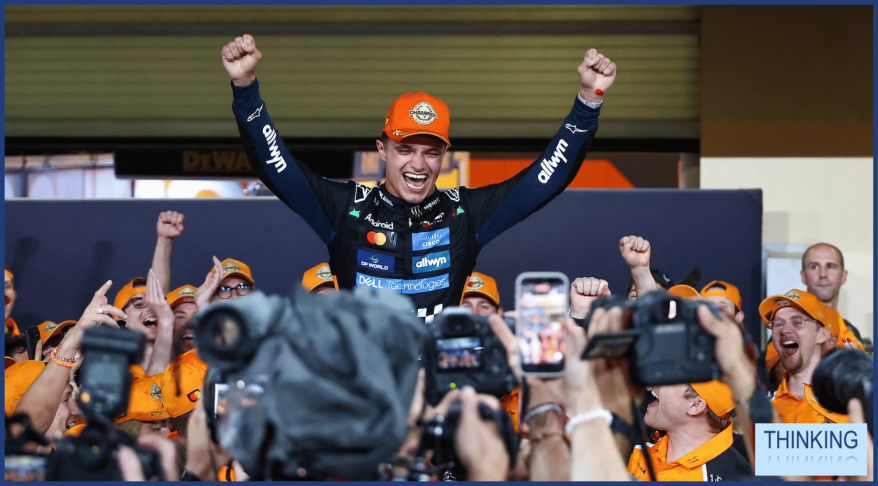
McLaren's 2025 double championship
McLaren's 2025 season was a triumph of engineering - but engineering alone did not win the double championship. McLaren secured the Constructors' Championship, while Lando Norris won the Drivers' Championship at the Abu Dhabi finale. Across the season, Norris and Oscar Piastri each won seven Grands Prix.
The MCL39 was fast. The simulations were sophisticated. The data was extensive.
But none of that matters if people cannot make decisions before pressure arrives, execute with precision when the moment comes, trust each other across the organisation, and sustain performance through a long and difficult campaign.
That is the real business lesson from McLaren. Human capital is not simply the number of talented people an organisation employs. It is the organisation's ability to develop knowledge, practise skill, build decision-making ability, and shape the character required to perform when the stakes are highest.
The car was the output. The people were the system.
The Strategy LabDecisions were made before the crisis
The most effective decisions are rarely invented in the moment of crisis. In Formula 1 the race may change in seconds; predictability is almost a non-existent word. A Safety Car, tyre degradation, rain, traffic, mechanical risk or a competitor's strategy can change the entire equation.
A Safety Car is a strategic fork in the road. Once deployed, every team faces the same question:
- Pit now - lose track position, but gain fresher tyres.
- Stay out - keep position, but risk being overtaken by those on newer rubber.
That decision must be made before the cars reach the pit entry - roughly four seconds in real time.
When your organisation faces its make-or-break moment, can you decide in four seconds?
Teams that respond well are not starting from zero. They do not call emergency meetings, review committees or task teams.
The head of strategy has already mapped the scenarios. The team has simulated the situation enough times to decide. The priorities are known and communicated. Everyone knows how decisions will be reached. That is what preparation and readiness look like.
At the Spanish Grand Prix, McLaren executed a two-stop strategy to secure a one-two finish, with Piastri winning ahead of Norris. The race also included a late Safety Car - a moment that can disrupt even a strong plan. The important point is not that McLaren could predict every event; no organisation can do that. The point is that the team had enough strategic clarity to respond without losing coherence. Drivers, engineers, strategists and mechanics understood the objective. They could adapt the method without abandoning the mission.
Business translation
Your organisation should not be making critical decisions in crisis mode. Scenario planning, risk assessment and pre-mortems are not academic exercises - they are the difference between winning and losing when seconds matter.
In crisis mode, decision-making is slowed by uncertainty, internal politics, incomplete information and fear of accountability. The best organisations do not predict the future perfectly. They prepare their people to recognise the moment when the plan must change.
The pit crew was a masterpiece of human-capital investment
A pit stop may last only seconds, but it represents years of human-capital development. Behind every clean stop is technical knowledge, physical skill, rehearsed coordination, role clarity, performance discipline and confidence in the people beside you. Every individual must understand not only their own role, but how that role connects to the success of the whole system.
That is human capital in action. The pit crew is not a collection of individuals working beside one another - it is a coordinated performance system. People are trained to act with precision, communicate without unnecessary noise, recover from mistakes and remain focused under extreme time pressure.
McLaren's 2025 success should not be read as evidence that every pit stop or hand-off was perfect. At Singapore, Piastri experienced a slow stop caused by a left-rear issue, while the team also faced disagreement over driver pit-stop sequencing. That is precisely why the pit-stop metaphor matters.
The pit crew was not just technically skilled; they were psychologically prepared. The value of human capital is demonstrated not only when everything goes right, but when people can identify a problem, contain its impact, stay coordinated and keep competing for the broader objective.
The insight most often overlookedBusiness translation
Every organisation has pit stops. They happen when sales hands a customer to operations; when product hands a design to manufacturing; when strategy is translated into frontline action; when a new employee moves from recruitment to onboarding; when a customer complaint moves from service to leadership.
Technical skills are necessary but insufficient. Your people also need psychological preparation - the ability to deliver under pressure without breaking, the resilience to recover and the confidence to execute when stakes are highest. That does not happen automatically; it requires intentional investment in human-capital capability.
Technology can accelerate a process. Only people can make the process reliable.
Trust flowed in both directions
The most powerful image in Formula 1 is not the driver alone in the cockpit. It is the driver listening to the radio. When Norris heard "Box, box, box", he did not hesitate, argue or ignore the call. He trusted it instantly. Why?
A world-class driver has exceptional skill, courage and competitive instinct - yet the driver does not see the entire picture. The pit wall can see tyre models, weather patterns, competitor movements, fuel projections, timing gaps and strategic possibilities that are invisible from the cockpit. At the same time, the pit wall cannot fully feel what the driver feels: the changing balance of the car through a corner, the grip level at the edge of performance, or the precise pressure of a competitor in wheel-to-wheel racing.
This is why trust must flow in both directions. The driver must trust the team's data and strategic perspective. The team must trust the driver's technical feedback and judgment. Neither side is superior. Each holds a different part of the truth.
McLaren had spent the entire season building psychological safety and mutual trust. Norris knew the strategy team had access to data he did not have, and that they had simulated the scenario hundreds of times. And the strategy team trusted Norris to execute - to hit his marks in the pit box, manage the restart and deliver the victory.
This two-way trust did not happen overnight. It was built through thousands of small interactions: strategy briefings where drivers were included in decision-making, debriefs where everyone from the most junior engineer to the driver was encouraged to speak honestly, and a culture where mistakes were treated as learning opportunities rather than blame assignments.
A driver accepting a strategic instruction is not surrendering skill or authority. The driver is recognising that elite performance comes from combining individual judgment with collective intelligence.
In corporate life, this is where many organisations fail. Leaders assume data from the centre is more valuable than operational insight from the frontline. Frontline teams then assume senior leaders do not understand reality. Both sides become defensive. Information is withheld. Decisions become political. Trust disappears.
Business translation
Trust is an organisational superpower. When employees trust leadership, they execute decisions without hesitation. When leadership trusts employees, it empowers them to act. Building that trust requires transparency, inclusion and a culture that treats mistakes as data rather than failure - a culture where autopsies are conducted without blame.
Employees do not need to win every argument to feel respected. They need to know their knowledge matters, their voice is heard, and decisions are made fairly.
Human-performance investment paid dividends
Winning a championship requires more than attracting talented people. It requires developing them, aligning them, supporting them and sustaining their performance over time. McLaren's results demonstrate the value of that system: Norris won the Drivers' Championship by two points, while Piastri finished third in the standings after a season in which both drivers won seven races.
That level of performance does not emerge from individual talent alone. It requires a wider environment that enables talented people to learn, contribute, recover and compete: engineers who can build and improve, strategists who can make difficult calls, mechanics who can execute consistently and precisely, leaders who can maintain direction, and drivers who can perform while carrying the weight of individual and collective expectation.
It also requires character. In Singapore, Norris and Piastri had visible tension after contact on the opening lap. Piastri described Norris's move as "not very team like", yet both drivers still contributed the points McLaren needed to secure the Constructors' Championship. That is a more meaningful picture of culture than a story of permanent harmony.
Strong cultures are not places where talented people never disagree. They are places where a disagreement does not destroy the mission.
On culture under pressureThe entire McLaren team - engineers, mechanics, strategists - had access to the same performance resources. McLaren understands that a tired engineer makes mistakes, a stressed strategist makes poor decisions and a burned-out mechanic loses focus. So they invested in the whole person: physical health, mental wellbeing, nutrition, sleep and stress management. Not as a perk, but as a performance requirement.
Business translation
Your people cannot perform at their best if they are exhausted, stressed and burned out. Investing in employee wellbeing is not "soft" - it is a competitive advantage. Organisations that treat human performance as a strategic priority will outperform those that treat it as an afterthought.
Employees remember whether an organisation merely used their talent or genuinely developed it.
Strategy is carried by people: four lessons for your boardroom
The 2025 McLaren Formula 1 season was not just a sporting event. It was a masterclass in organisational performance under pressure - and the lessons translate directly to the corporate boardroom.
Lesson 1: Make decisions before you need to
McLaren does not decide to pit its drivers during the Safety Car. They decide weeks earlier, through thousands of simulations and scenario-planning sessions.
Application
What critical decisions is your organisation currently deferring? What scenarios might you face in the next six months - market disruption, regulatory change, key talent attrition? Have you prepared for them, or will you be scrambling when they happen? How prepared and ready are you?
Lesson 2: Invest in human capital, not just technology
McLaren did not win the championship by designing a better car. They won by building a better team - a team capable of designing a better car, executing a better strategy and performing under pressure. The car was the output. The people were the system.
Application
Are you investing in your people's development, wellbeing and capability - or expecting better results from the same tired, disengaged workforce? Do your employees have access to development opportunities, performance coaching and wellbeing resources? Remember: human capital appreciates when you invest in it. It is not a cost; it is a competitive weapon.
Lesson 3: Build trust through inclusion and transparency
Norris and Piastri trusted the strategy calls because they were included in strategy discussions all season. The pit crew trusted each other because they had practised together thousands of times. The strategy team trusted the data because they had access to the best tools and information.
Application
Does your organisation foster two-way trust? Are employees included in decision-making? Is information shared transparently? Trust is not built through slogans - it is built through consistent behaviours that demonstrate respect, inclusion and integrity.
Lesson 4: Prepare your people psychologically
Technical skills matter. But under pressure, psychological preparation is what separates winners from losers. McLaren's pit crew practised under simulated stress. Norris and Piastri had access to sports psychologists who helped them manage the pressure of a championship fight.
Application
Are you supporting your employees as whole people, or treating them as machines to be optimised? Do they have the resilience, focus and confidence to execute when stakes are highest? Psychological preparation is not optional; it is essential for high performance.
The invitation from The Strategy Lab
A survey conducted by the Economist Intelligence Unit revealed that barely 40% of executives rated their companies as being successful at execution.
Andrew MacLennanThe execution gap is not simply a process problem. It is often a human-capital capability problem.
The 2025 Formula 1 season is over. McLaren lifted the trophies. The champagne has been sprayed. The celebrations have ended. But the lessons remain. The most important one is this: in a world where technology is increasingly commoditised, competitive advantage comes from people.
Formula 1 teams understand this. They spend more on human performance than on anything except the car itself. They build organisations designed to bring out the best in every individual. They create cultures where collaboration beats hierarchy, preparation beats reaction, and trust beats control.
What would your organisation look like if you applied the same principles? What if you invested in your people the way McLaren invests in theirs? What if you prepared for challenges the way McLaren prepares for races? What if you trusted your team to execute the way McLaren trusts theirs?
These are the questions at the heart of our work at The Strategy Lab. We partner with organisations and empower them to translate the principles of high-performance teams into the corporate boardroom. Using real-world examples from Formula 1 and rigorous frameworks from organisational theory, we capacitate leaders to build teams that can perform under pressure, adapt to change and deliver results when it matters most.
McLaren's championship, 17 years in the making, has shown what is possible when human-capital capability sits at the heart of strategy execution.
To what extent is your organisation leveraging human capital to win its own Grand Prix?
The race is already underway.
Start the conversation
The championship is won by the team that prepares best - and that team can be yours.
If you are ready to explore how high-performance human-capital strategy can transform your organisation, let's talk.